
Children and dogs: building a safe friendship
What research says about growing up with a dog (empathy, allergy risk) and how, as a parent, you build a safe, respectful bond between child and dog.

“A dog teaches children responsibility” and “never leave a child alone with a dog” can both sound like lines you’ve heard a hundred times. The problem is that the first is a myth if left unqualified, and the second is the single most important rule there is.
The most important rule upfront: never leave young children and dogs together unsupervised. Even the sweetest dog can get startled or be in pain.
What a dog can give a child, and what isn’t proven
The idea that “having a dog at home makes your child more sociable and empathetic” is often sold as settled fact, but the research behind it is less clear-cut. A frequently cited 2003 American study (Daly & Morton) of 137 children found no general difference in empathy between children with and without a pet. Against that stands a large Australian cohort study (Christian et al., 2020, The Journal of Pediatrics) that did find a link between pet ownership and more prosocial behaviour and fewer emotional problems in children. Both camps acknowledge the same problem themselves: it’s hard to separate whether the dog itself causes that effect, or whether families that are already warm and stable simply tend to get a dog more often.
For stress, the evidence is a bit more direct. In an experiment where children aged 7 to 12 underwent a standardised stress test (Kertes et al., 2017, Social Development), children with a dog in the room felt significantly less stressed than children alone or with a parent present. A Spanish study from 2022 (PLOS ONE) found that schoolchildren who had a dog-focused session twice a week showed a measurable drop in salivary cortisol after four weeks.
The allergy question: what the hygiene hypothesis does and doesn’t say
Around dogs and allergies, both the idea that they protect and the idea that they raise risk circulate. A Swedish registry study covering the entire birth cohort (Fall et al., 2015, JAMA Pediatrics) found that exposure to a dog in the first year of life was associated with 13% less asthma at school age. More recent research, presented at the 2025 European Respiratory Society congress, found babies with more dog allergen in their household dust had nearly half the asthma risk at age 5.
That isn’t the whole story. A large meta-analysis of early pet exposure in more than 77,000 children found no unambiguous protective effect, and not every study points the same way. Sum it up as: there’s repeated, cautious evidence for a protective effect from early exposure, certainly not a guarantee, and not a reason to get a dog if your child already has an allergy.
Teach your child the dog’s language
This is the part that matters most. Dog bites in children happen more often than most parents think, and more often close to home than you’d expect: in the Netherlands, Utrecht University estimates the number of dog bites at around 150,000 a year, and among fatalities between 1982 and 2007, 20% were under 5, while that age group makes up only 6.5% of the population (figures from the Sophia Vereeniging report “Hondenbeten in perspectief”). Young children don’t yet have the developmental level to grasp a dog’s perspective, and so often miss the warning signals a dog almost always gives first.
Dogs speak with their bodies, in stages, long before growling or snapping. Teach your child (at their level) the early signs that a dog isn’t enjoying something right now:
- walking away or turning its head away
- lip licking, yawning without being tired
- the whites of the eyes showing (“whale eye”)
- going stiff, a low growl
Growling isn’t misbehaviour, it’s communication: the dog is saying “give me space.” Don’t punish it away, instead, teach your child to listen to it. A dog that learns growling gets punished sometimes simply skips that warning next time, without the underlying tension being resolved, which is far riskier. For more on these signals and how they escalate as tension rises: dog body language: reading stress signals.
The Belgian project De Blauwe Hond (The Blue Dog), developed by behavioural veterinarian Tiny De Keuster (Faculty of Veterinary Medicine, Ghent University), teaches children under 7, through an interactive character, that most bite incidents happen with a dog they already know, that you should never run from a dog, and that you should leave a sleeping or eating dog alone. A peer-reviewed evaluation (Journal of Pediatric Psychology) found a measurable learning effect that lasted up to a year. Importantly, and emphasised by the researchers themselves: that knowledge doesn’t replace supervision. Even trained children sometimes still read an angry dog as friendly.
House rules that work
A few clear agreements prevent most problems:
- Leave the dog alone while eating and sleeping. The bed and the food bowl are the dog’s safe zone, nobody touches those.
- No hugging around the neck or on top of the dog. Many dogs find that stifling, even if they tolerate it.
- Approach calmly, no chasing. No pulling ears or tail, no screaming or running after the dog.
- The dog may always leave. Provide a spot where the dog can retreat, and teach your child to respect it.
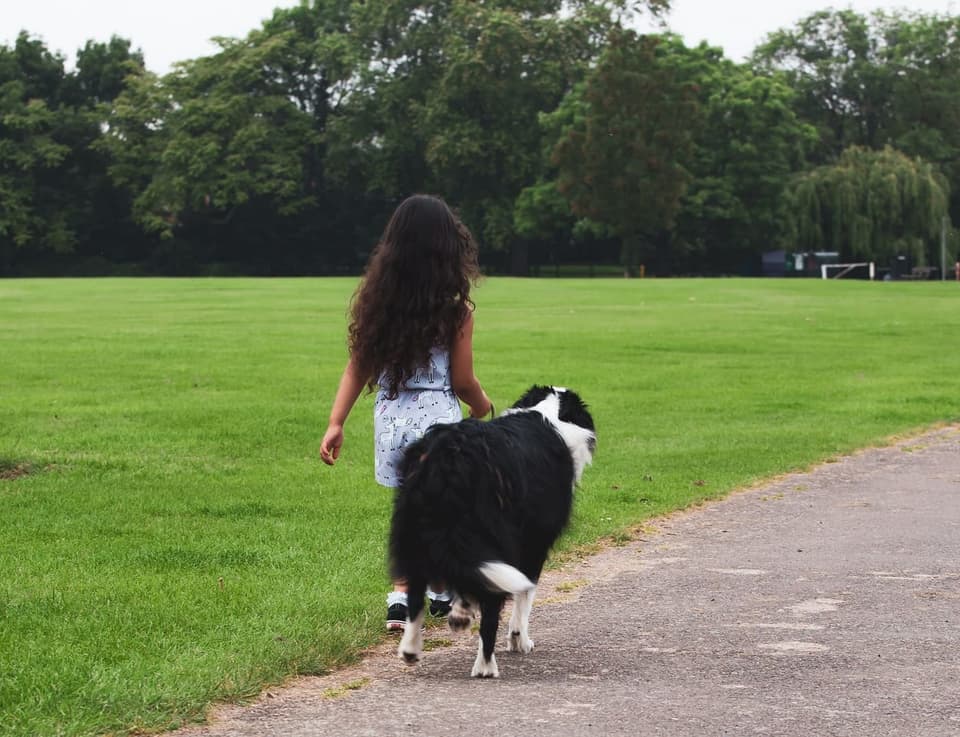 Out together under supervision: a child who handles the dog calmly naturally builds trust.
Involve your child, at their own pace
Children who help out build a bond faster, always under supervision and with age-appropriate tasks:
- Under 5-6: no independent tasks, but helping out under full supervision: putting dry food that’s already been measured by an adult into the bowl, gentle co-brushing.
- 6-9: feeding and giving a treat with a flat hand under direct supervision, helping with basic care.
- 10 and up: remembering feeding times, topping up the water bowl, learning to hold the leash with an adult as backup.
- From around 14: most adult tasks, with occasional checking in.
What age a child can walk the dog alone doesn’t come down to a fixed number, but to a combination of factors: how big and strong is the dog, how reliable is their obedience, and how well can the child judge risk? Build it up step by step, first together, then at a short distance within your sight, before letting a child walk the dog fully independently. The common idea that “a dog teaches your child responsibility” only holds true if it’s set up that way: final responsibility for the dog’s wellbeing always rests with the parents, however willingly a child helps.
A new baby in a family with a dog
If a baby is joining a family that already has a dog, prepare the dog gradually, ideally one to two months in advance: get them used to baby sounds (play a recording or baby monitor audio in advance), to the smell of baby care products, and practise calm behaviour around a pram. Make routine changes that will happen after the birth anyway (for instance, no longer being allowed on the sofa) before the birth itself, so the dog doesn’t associate them with the baby’s arrival. Brush up on basic obedience. At the first introduction: one adult handles the baby, another the dog, and let the dog sniff at its own pace.
Notice your dog reacting with noticeable stress to these changes? Talk to a dog training school or behaviourist in good time, ideally before the baby arrives rather than after.
When professional help is worthwhile
If your dog stays clearly stressed around children (persistent panting, refusing to eat, continually retreating, or increasing growling instead) don’t wait it out. Give the dog space immediately, and seek professional help from a dog training school or a certified behaviourist. See also our guide on dog behaviour therapy: what is it for what such a process involves.
Does the kid-friendly dog breed exist?
Lists of “best dog breeds for families with children” are everywhere, but behavioural research doesn’t back them up. The American Veterinary Medical Association (AVMA) states explicitly that the link between breed and bite risk is weak to absent, pointing instead to individual behaviour, socialisation, spaying/neutering and proper supervision as the factors that actually matter. A dog that does well with one child may react differently to another, especially if that child is younger, louder or more unpredictable.
If you’re choosing a dog, look beyond appearance: temperament and energy level matter more than breed. A good breeder or a shelter that knows its dogs well can help you find a match that suits a busy family. And a dog training school helps the whole family stick to the same, clear approach from day one.
With patience, supervision and respect for each other’s boundaries, a friendship for life grows between child and dog. Looking for a dog training school or other services nearby? Browse them on GoPuppy.
Frequently asked questions
At what age can a child walk a dog by themselves? That depends on both the child and the dog: the dog’s size and pulling strength, how reliable their obedience is, and the child’s judgement all play a role. Holding the leash independently is rarely recommended before around age ten, and only let a child walk a dog alone once you have, after repeated supervised walks, full confidence in both of them.
Is growling at a child a sign the dog is dangerous? No, growling is communication, not aggression in itself, the dog is saying “give me space.” Don’t punish it away, since that can remove the warning without resolving the underlying tension. Do take it seriously and work out what’s bothering the dog.
Does a dog make my child more sociable or empathetic? Research on this is mixed. Some studies find a link with more prosocial behaviour, others find no general difference in empathy. What’s clear is that it’s hard to separate whether the dog itself causes that effect, or whether families that are already warm and stable simply get a dog more often.
Does a dog lower my child’s asthma risk? There’s repeated research showing early exposure to a dog, especially in the first year of life, is associated with less asthma at school age. It isn’t a guaranteed effect and the evidence comes from observational research, not controlled trials.
Which dog breed suits a family with children best? There’s no universal “kid-friendly breed”: the AVMA explicitly points to individual temperament, socialisation and upbringing as the factors that matter. A good breeder or shelter will help you find a match based on energy and temperament, not just looks.
How do I prepare my dog for a new baby? Gradually get them used to baby sounds and smells, practise calm behaviour around a pram or baby items, and keep your dog’s routines as unchanged as possible. Consider discussing this in good time with a dog training school if your dog stresses easily.
What do I do if my dog is clearly stressed by a child? Give the dog room to move away straight away, and provide a fixed, calm spot where they can retreat. If the tension persists, professional help from a dog training school or behaviourist is a good next step. See also our guide on dog behaviour therapy.