FCI 143 · Germany

Dobermann

A German working dog, the only German breed named after its breeder. The Royal Kennel Club puts his exercise needs at more than two hours a day, and a heart check belongs with the breed.

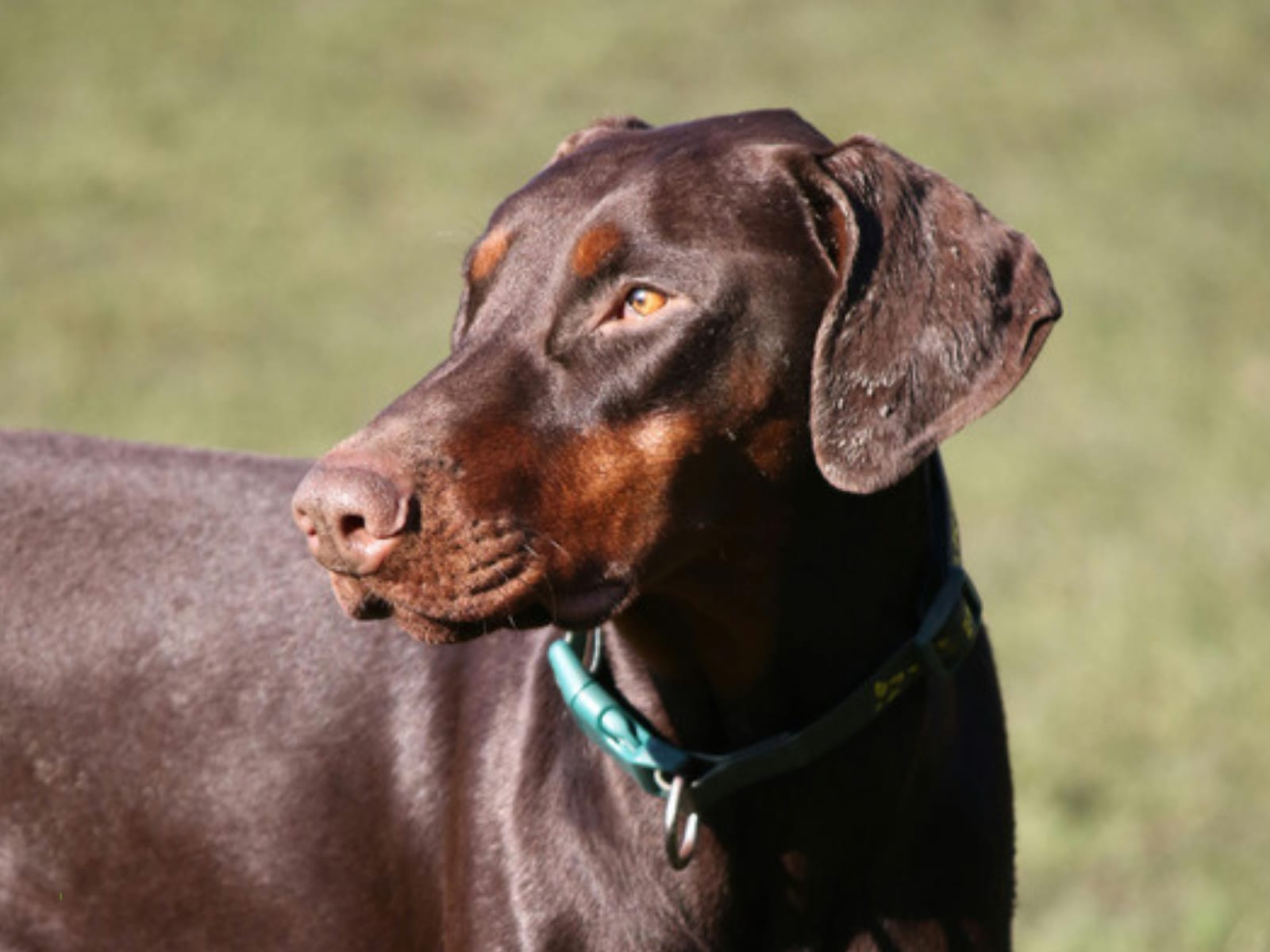
Brown Dobermann with natural ears outside on the grass

Breed facts

FCI
no. 143 · group 2, pinschers and schnauzers
Origin
Germany
Height at withers
male 68–72 cm · female 63–68 cm
Weight
male 40–45 kg · female 32–35 kg
Exercise
more than 2 hours a day (according to the Royal Kennel Club)
Lifespan
over 10 years
Coat
short, sheds

The GoPuppy profile

These are breed averages and our own assessment. Your own dog’s age, fitness and training matter more.

  1. WalkingFull-day hikesMore than two hours of exercise a day, according to the Royal Kennel Club. A fit Dobermann can manage a full-day hike.
  2. Dog sportSport with a build-upThe standard asks for a dog that enjoys working; canicross, obedience and IGP fit that. Have his heart checked before you step up training; the study by Wess et al. recommends yearly screening from two years of age.SuitscanicrossobedienceIGPscent work
  3. Terraces and cafésTerrace after trainingThe standard calls him 'friendly and calm' and 'very devoted to the family'. Given his size and alertness, a quiet terrace suits him better than a busy market.
  4. Travel and staysTravel takes preparationAt 32 to 45 kg and up to 72 cm at the withers, he needs a large crate or a good part of the boot. Check whether your accommodation has a size limit.
  5. CityNeeds a big gardenThe Royal Kennel Club assumes a large house with a large garden. In a city he needs a long walk every day or an hour of running in an off-lead area.

Character

The FCI standard asks for a “medium temperament” and “a good contact to the owner”. He is easy to train and likes to work. That makes him a strong sports dog, as long as training starts early and stays regular.

Origin

Friedrich Louis Dobermann (1834 to 1894) bred the breed in the 1870s. According to the standard, he was a tax collector, ran a knacker’s yard and caught stray dogs. He crossed butcher’s dogs, an early type of Rottweiler, with a black shepherd dog with rust-red markings from Thuringia. The breed was widely used as a guard and police dog, which earned it the nickname ‘Gendarme dog’. The FCI places it in Group 2, with a working trial.

The heart

In a German study (Wess et al., 2010), 412 European Dobermanns, some of them more than once, had a heart scan and a 24-hour Holter. The cumulative prevalence of cardiomyopathy came to 58.2 percent, and the condition was more common in older dogs. The authors recommend yearly screening from two years of age. Ask a breeder about the parents’ heart tests and discuss screening with your vet.

Size

Males measure 68 to 72 cm and weigh about 40 to 45 kg, females 63 to 68 cm and about 32 to 35 kg.

Health: what a good breeder tests for

  • Heart: yearly screening with echocardiography and a 24-hour Holter from two years of age (recommendation by Wess et al., 2010)
  • DNA test for von Willebrand disease (vWD1)
  • DNA test for DINGS2
  • Eye examination (PHPV) and hips

Ask for the parents’ results when you visit a litter. This is not medical advice; your vet knows your dog.

Breeders of this breed on GoPuppy

No breeder of this breed on GoPuppy yet.

GoPuppy does not check breeders’ health tests. A listing here is not a seal of approval.

Read also