FCI 37 · Portugal

Portuguese Water Dog

The constant helper of Portuguese fishermen. He jumped into the sea to bring back escaped fish and swam between boat and shore.

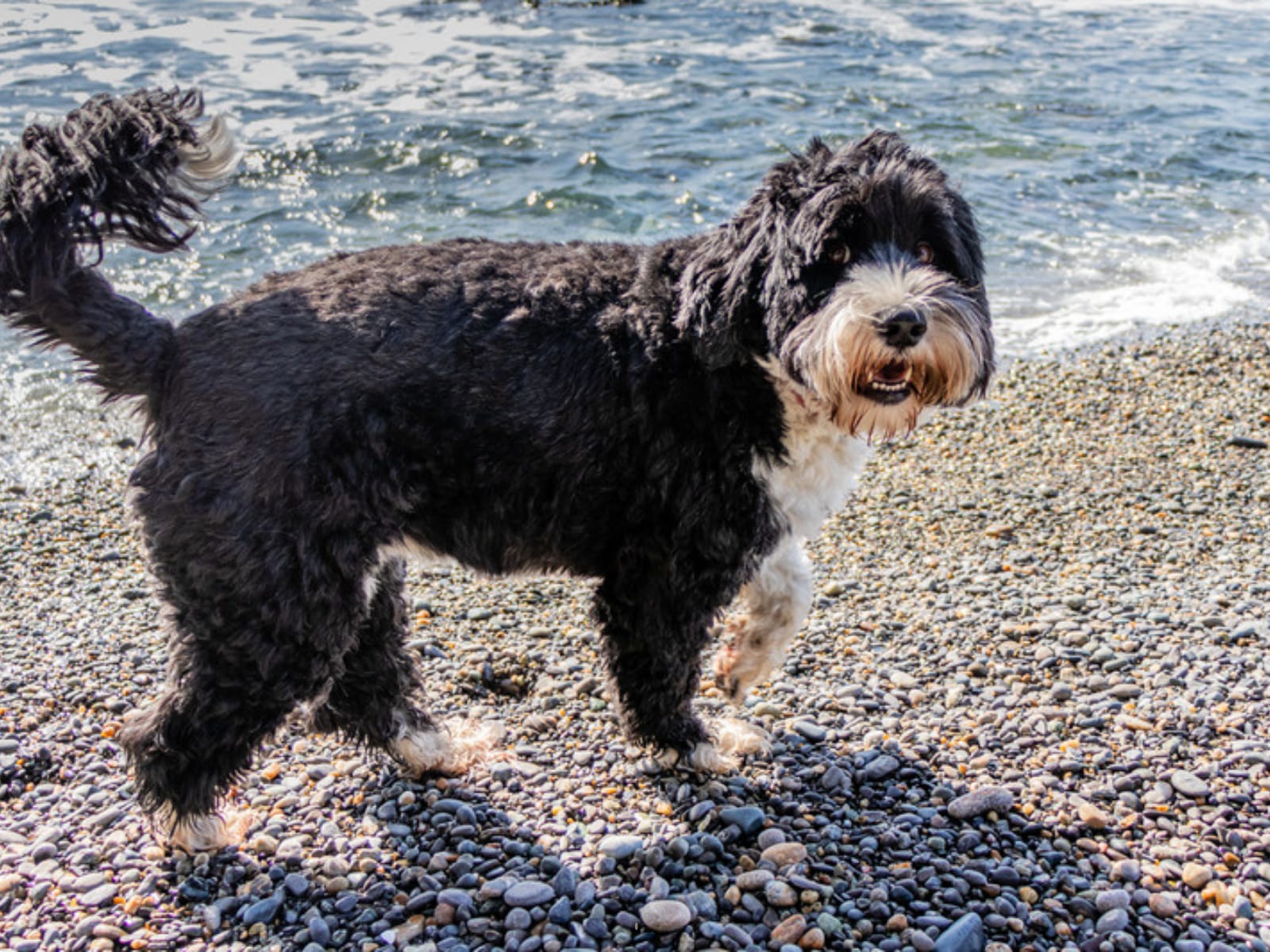
Portuguese Water Dog on a pebble beach

Breed facts

FCI
no. 37 · group 8, water dogs
Origin
Portugal
Height at withers
male 50–57 cm · female 43–52 cm
Size
Ideally 54 cm for males and 46 cm for females.
Weight
male 19–25 kg · female 16–22 kg
Exercise
up to 1 hour a day (according to the Royal Kennel Club)
Lifespan
over 10 years
Coat
medium length, sheds little

The GoPuppy profile

These are breed averages and our own assessment. Your own dog’s age, fitness and training matter more.

  1. WalkingLong walksThe Royal Kennel Club gives up to an hour a day. According to the standard he is resistant to fatigue, so he will happily go further.
  2. Dog sportSports partnerThe standard calls him an excellent swimmer and diver. Swimming, dummy training and agility suit him.Suitsswimmingagilitydummy training
  3. Terraces and cafésTerrace after trainingIntelligent and easy to direct. After some exercise he settles down.
  4. Travel and staysTravel takes preparationMedium-sized and easy to take along.
  5. CityBetter with a gardenThe Royal Kennel Club suggests a large house with a small to medium garden, in town or country.

Character

According to the FCI standard, the Portuguese Water Dog is exceptionally intelligent and obeys readily. He is impetuous, wilful and courageous, sober and resistant to fatigue. He has a severe, attentive expression, good eyesight and a good nose, and is an excellent swimmer and diver.

Origin

He was once found along the whole Portuguese coast. As fishing methods changed, he stayed mainly in the Algarve, now considered his birthplace. He was the fisherman’s inseparable companion: he jumped into the sea to retrieve escaped fish, dived when a net broke or a cable came loose, guarded the boat and carried messages between boats and shore. The FCI places him in Group 8, section 3, water dogs. GoPuppy also covers the Spanish Water Dog and the Lagotto Romagnolo.

Coat and health

The Royal Kennel Club lists him among dogs that do not shed; the coat needs daily care. The RKC puts genetic diversity first and asks for a DNA test for PRA (prcd-PRA). It also lists hip and elbow testing, a DNA test for GM1 gangliosidosis and one for an early-onset form of PRA (EOPRA).

Size

Males measure 50 to 57 cm (ideally 54) and weigh 19 to 25 kg. Females measure 43 to 52 cm (ideally 46) and weigh 16 to 22 kg.

Health: what a good breeder tests for

  • Prioritising genetic diversity when choosing the parents
  • DNA test for PRA (prcd-PRA)
  • DNA test for PRA (EOPRA)
  • DNA test for gangliosidosis (GM1)
  • Hips (X-ray, official result)
  • Elbows (X-ray, official result)

Ask for the parents’ results when you visit a litter. This is not medical advice; your vet knows your dog.

Breeders of this breed on GoPuppy

No breeder of this breed on GoPuppy yet.

GoPuppy does not check breeders’ health tests. A listing here is not a seal of approval.

Read also