
Puppy feeding: how much to feed a puppy and how often
How often to feed a puppy, how much puppy food to give and when to switch to adult food. With the rib check, large breeds, treats and water.
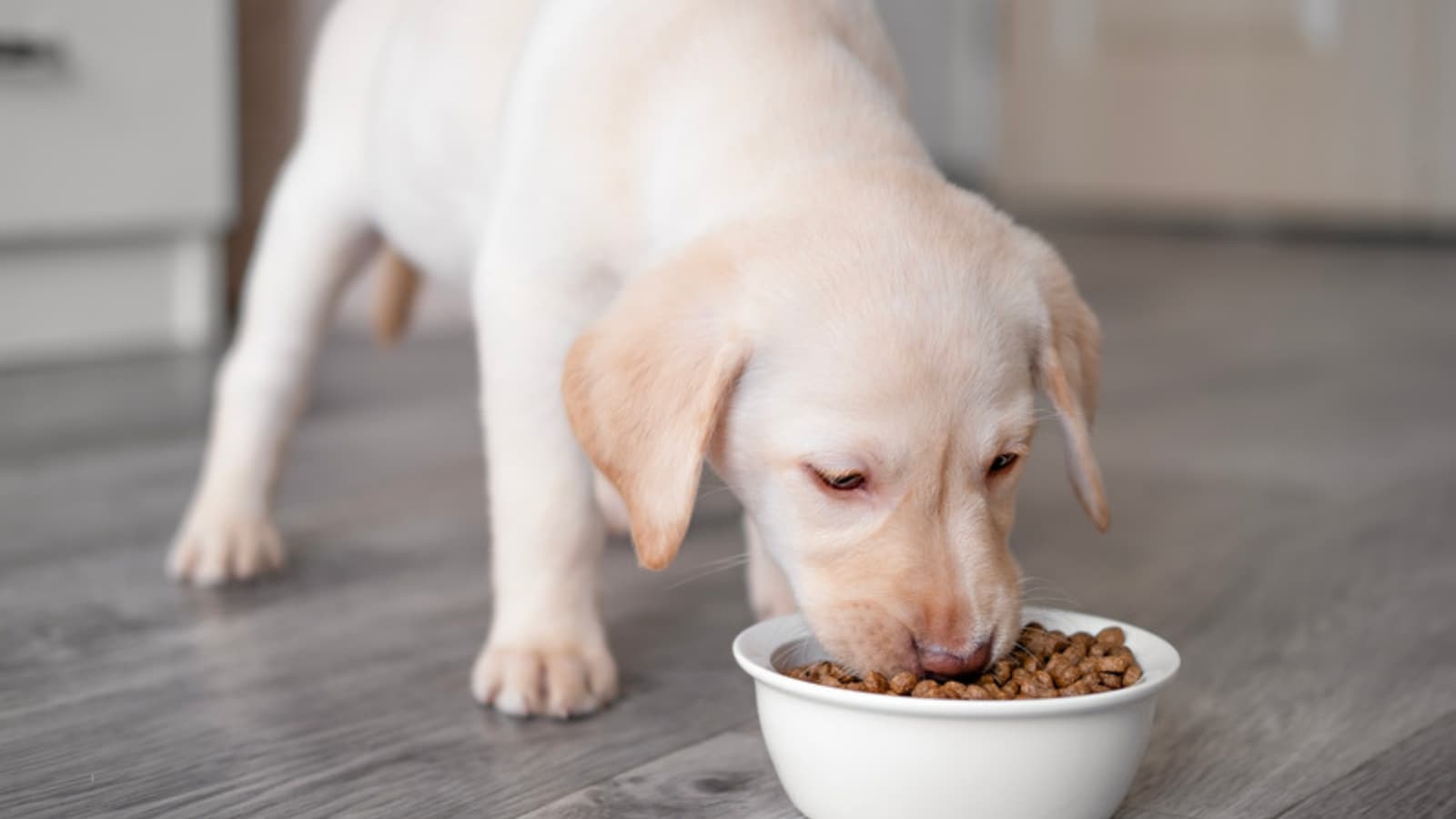
A young puppy’s food is split into four meals a day. At around three months you go down to three, and from about six months two are enough. That is the schedule in the puppy leaflet from the LICG, the Dutch national information centre for companion animals, which adds that it varies by breed and by dog. For the daily amount, start with the packet. After that, adjust with your hands: you should be able to feel your puppy’s ribs easily. Stay with the breeder’s food for the first weeks and count every treat.
This information is no substitute for a vet. Every puppy grows at its own pace. If you have doubts about his growth or about a change of food, talk to your vet.
How often to feed a puppy
The LICG schedule is simple: four meals for a young puppy, three from about three months, two from six months. Other sources draw the lines slightly differently. The American Kennel Club (AKC) keeps four meals up to twelve weeks and moves to three somewhere between three and six months. The MSD Veterinary Manual, a reference work for vets, works with three meals from weaning to six months and two from six to twelve months. According to the manual, a small-breed puppy may need more than three meals.
Feed at set times and give a measured portion each time. The AKC advises not leaving the bowl down for more than a quarter of an hour. Whatever your puppy hasn’t eaten by then, you take away until the next meal. That way you notice straight away if his appetite changes, and he learns that food comes at a fixed time. Take him outside briefly after every meal, because a puppy often needs a wee soon after eating. There is more on that routine in puppy at home.
Large dogs with a deep chest are most at risk of bloat with gastric torsion, where the stomach twists on its axis and swells. The LICG calls it very dangerous. To lower the risk, it advises keeping your puppy calm for an hour before and two hours after eating, with no wild play or running.
How much food does a puppy need
Start with the table on the packet. The LICG points out that these feeding guides are meant for an average dog, and your puppy may not be one. A puppy who charges about all day burns more than a quieter one. The AKC sums it up as “watch the dog, not the dish”: your puppy’s body condition sets the portion, whatever is left in the bowl.
You check that condition with your hands. The WSAVA, the World Small Animal Veterinary Association, uses a scale from 1 to 9. At a score of 4 or 5 you can feel the ribs without excess fat over them. From above you can see a waist behind the ribs, and from the side the belly tucks up towards the back. At 6 there is already a slight layer of fat over the ribs. At 7 you can only feel them with difficulty. Lay your flat hand on his side and stroke gently over the ribcage. The scale was designed for dogs in general, so for a puppy in full growth it is best to have your vet take a look as well.
Weigh your puppy regularly. The MSD Veterinary Manual advises monitoring weight gain weekly. The LICG has a handy trick: step on the scales holding your puppy, then subtract your own weight. Ask your vet how heavy he should be and how much he should gain each week. Too light isn’t a good sign either. According to the LICG, Labradors and Golden Retrievers put on weight quickly, so keep a closer eye on those breeds. Note down his weight with the date each time and you’ll see the growth curve. Our own book My puppy journal follows your puppy’s growth stage by stage.
Puppy food or adult dog food
A growing puppy has different needs from an adult dog. The LICG writes that puppy food is tailored to growing dogs and has the right balance of ingredients. The PDSA, a UK veterinary charity with its own pet hospitals, recommends a complete food that is clearly labelled for puppies. There are also versions by size, for small breeds and for large or giant breeds. The label tells you whether it is a complete food.
The LICG advises against putting together your own menu for a young dog without advice from a nutrition specialist. Getting the proportions wrong can lead to poor skeletal development and weak bones in a growing dog. According to the LICG, supplements should only be given after talking to a vet, and with a complete food they are usually unnecessary. Milk isn’t needed either. The PDSA writes that a fully weaned puppy no longer needs milk, and that milk adds a lot of extra calories.
GoPuppy does not recommend brands. Your vet or a pet shop can help you choose a food that suits your puppy’s breed and age. Whether to buy it in a shop or online is covered in pet shop or order online.
Large breeds: slow and steady growth
With large and fast-growing breeds you need to keep a close eye on growth and choose the right food. Otherwise, according to the LICG, there is a risk of growth deformities. The MSD Veterinary Manual recommends a complete growth diet made for large breeds for large and giant-breed puppies, and writes that a slow growth rate is preferable to a fast one. A chubby puppy shooting up fast is therefore no sign that all is well.
Calcium needs extra care. According to the same manual, between weaning and about six months a puppy cannot yet properly regulate how much calcium it absorbs from the gut when there is too much in its food. Excess calcium is mainly a problem in large and giant breeds that are still growing. In studies, food with more than 3 per cent calcium on a dry-matter basis caused more severe signs of osteochondrosis, a developmental disorder of cartilage and bone, in fast-growing large dogs than food with 1 to 3 per cent. The manual also warns against adding minerals indiscriminately. So don’t sprinkle extra calcium or bone meal over a complete puppy food.
Switching from the breeder’s food
To begin with, give the same food as the breeder. The LICG explains that a sudden change of food can upset the stomach and gut, and a puppy in a new home already has plenty to take in. The AKC advises keeping the breeder’s food for at least two weeks if possible. So ask the breeder which food they use and how much. Some breeders send a small supply home with you. How to spot a good breeder is covered in how to spot a reliable dog breeder.
If you want to switch after that, do it gradually. The AKC allows five to seven days:
- For the first two or three days, give about three quarters old food and one quarter new.
- For the next two or three days, half and half.
- After that, three quarters new food and one quarter old.
- If all goes well, give only the new food.
So allow roughly a week. The PDSA prefers to take a couple of weeks. VCA, a US chain of veterinary hospitals, advises slowing down if your puppy gets loose stools, vomits or eats less. If things haven’t settled after 24 hours, call the vet.
Treats count too
Rewards during training are food. The PDSA advises keeping treats under 10 per cent of the daily food allowance and cutting the usual food by the same amount. You could set that 10 per cent aside in the morning as the day’s treat supply. The LICG suggests using part of the daily ration itself as training kibble. A puppy gets a lot of rewards in the first months, so that makes quite a difference. How to go about it is in puppy training in the first months.
If several people live in the house, weigh out the whole day’s ration in a closed tub in the morning. Whoever trains or feeds the puppy takes from it. Whatever is left in the evening becomes the last meal. That way he doesn’t end up with double portions because three family members each slipped him something.
Water
According to the AKC, a puppy should have access to fresh water at all times. The PDSA advises sticking to puppy food and clean, fresh water. Put the bowl in a fixed spot, out of the way of foot traffic, and refresh the water regularly.
What a puppy mustn’t eat
The PDSA advises against giving your puppy human food or scraps. Some dishes unbalance his diet, and some are downright toxic. Chocolate, grapes and raisins, the xylitol in sugar-free chewing gum and onion top the list, as do cooked bones. Which foods are dangerous and what to do if your puppy has eaten some is covered in what can’t dogs eat.
Raw feeding for a puppy
Raw feeding, also known as BARF, is popular. Veterinary organisations are cautious about it. The WSAVA Global Nutrition Committee recommends that raw meat-based diets not be fed to dogs and cats. According to the committee, there is no properly documented evidence of health benefits, while the risks are well documented. It mentions contamination with bacteria and parasites, an unbalanced diet and the risks of bones, such as constipation, diarrhoea, broken teeth and a blocked gut. The LICG writes that raw meat and raw fish can contain bacteria and parasites, and that it has not yet been proven that raw food is better than kibble or tinned food.
In 2018, researchers at Utrecht University tested 35 frozen products from eight brands on sale in the Netherlands. They found Salmonella in 20 per cent of the products and Listeria in 15 of them, as well as various parasites. These bacteria can pass from the dog to the people in the house, for example when he licks you. If you are thinking of feeding your puppy raw, discuss it with your vet first. In a growing dog, a mistake in the balance of the diet weighs more heavily.
When to switch to adult food
The timing depends mainly on the breed. The MSD Veterinary Manual advises continuing a growth diet until the skeleton has matured, and not stopping as soon as your puppy looks grown up. For small and medium breeds the manual puts that at around 8 to 12 months, and for large and giant breeds it can take 10 to 16 months. The AKC gives 7 to 9 months for small breeds and 12, 13 or even 14 months for larger ones. According to VCA, giant breeds sometimes don’t reach full physical maturity until around 24 months.
This change is also made gradually. VCA recommends 7 to 14 days, starting with 90 per cent puppy food and 10 per cent adult food. Bear in mind that the number of meals and the type of food change separately. A six-month-old puppy already eats twice a day, but usually still gets puppy food. The LICG advises discussing the moment to switch with your vet.
At every visit to the practice, the vet can keep track of his weight and condition. You’ll find a practice nearby among the vets on GoPuppy, and what to look for in that choice is in choosing a vet. All our articles on the first year with your puppy are in the puppy guide.
Frequently asked questions
How many times a day should a puppy eat? According to the LICG, a young puppy’s food is split into four meals a day. At around three months you can drop to three meals, and from about six months two are enough. This can vary by breed and by dog. The MSD Veterinary Manual keeps three meals up to six months and notes that a small-breed puppy sometimes needs more. Ask your vet what suits your puppy.
How much food does a puppy need? Start with the amount on the food packet. According to the LICG, that table is meant for an average dog, so adjust it to your puppy’s condition. You should be able to feel his ribs easily under a thin layer of fat, and from above you can see a waist behind the ribs. Weigh him regularly and ask your vet how much he should gain each week.
How do I switch from the breeder’s food? Start with the same food the breeder gave. The American Kennel Club advises sticking with it for at least two weeks if you can. To switch after that, mix in a little more of the new food each time. The AKC does it over five to seven days: first a quarter new, then half, then three quarters, and after that only the new food. If your puppy gets loose stools or vomits, slow down, and call the vet if it doesn’t settle.
When can my puppy move on to adult food? That depends mainly on the breed. The MSD Veterinary Manual advises feeding a growth diet until the skeleton has matured. For small and medium breeds the manual puts that at around 8 to 12 months, for large and giant breeds at around 10 to 16 months. The American Kennel Club gives 7 to 9 months for small breeds and 12 to 14 months for larger ones. Agree on the timing with your vet.
Can a puppy have treats? Yes, in moderation. The PDSA advises keeping treats under 10 per cent of the daily food allowance and cutting his usual food by the same amount. You can also use part of his kibble as rewards during training, as the LICG suggests. Leave out scraps from the table, as some foods are toxic to dogs.