FCI 327 · Russia

Black Russian Terrier

A large working dog created by the Russian army in the late 1940s, with the Giant Schnauzer as its main ancestor.

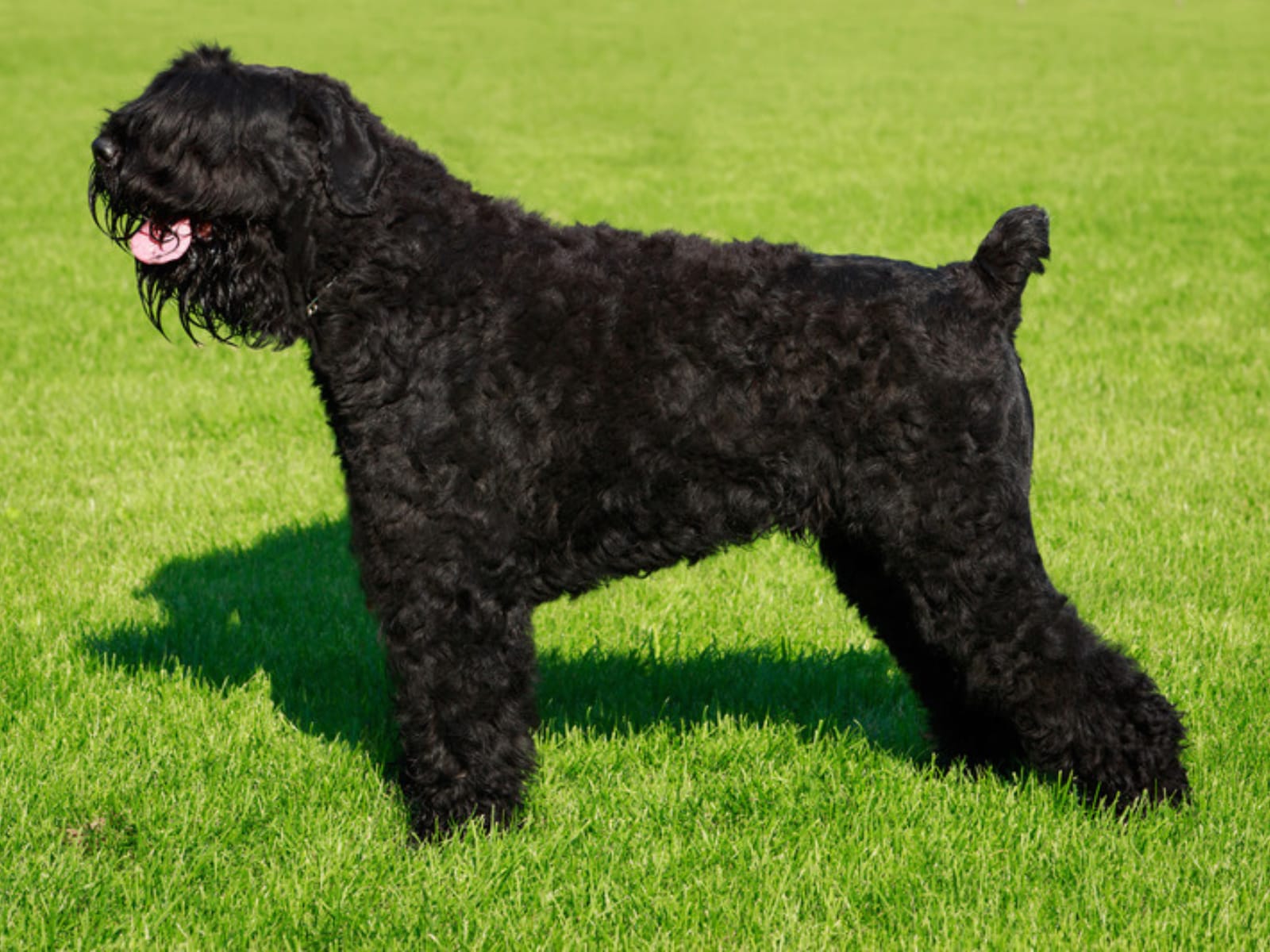
Black Russian Terrier standing on a lawn

Breed facts

FCI
no. 327 · group 2, pinschers and schnauzers
Origin
Russia
Height at withers
male 72–76 cm · female 68–72 cm
Size
The standard gives these as desired heights; dogs measure between 70 and 78 cm, bitches between 66 and 74 cm.
Weight
male 50–60 kg · female 45–50 kg
Exercise
more than 2 hours a day (according to the Royal Kennel Club)
Lifespan
over 10 years
Coat
medium length, sheds little

The GoPuppy profile

These are breed averages and our own assessment. Your own dog’s age, fitness and training matter more.

  1. WalkingLong walksThe Royal Kennel Club gives more than two hours of exercise a day.
  2. Dog sportSport with a build-upA working dog that adapts well to training. IGP, scentwork and obedience suit him.SuitsIGPscent workobedience
  3. Terraces and cafésRather not a busy terraceThe standard calls him dignified, confident and well controlled in all situations.
  4. Travel and staysRules or heat when travellingLarge. A roomy car or crate is needed.
  5. CityNeeds a big gardenThe RKC suggests a large house with a large garden, in town or country.

Temperament

According to the FCI standard the Black Russian Terrier is dignified and confident, well controlled in all situations. When needed he immediately takes an active-defensive posture, but calms down quickly once the threat has gone. He is amiable, undemanding, smart and has great endurance. He adapts well to training and to various climates and is hard-working and reliable.

Origin

He was created in Russia in the late 1940s and early 1950s by crossing breeds such as the Rottweiler, Giant Schnauzer, Airedale Terrier and Newfoundland, with the Giant Schnauzer as the main ancestor. Breeding was supervised by the military dog school outside Moscow, at the Red Star kennels. The FCI recognised the breed in 1984 and places him in Group 2, Section 1, pinschers and schnauzers.

Health

The Royal Kennel Club prioritises genetic diversity and lists elbow and hip testing and DNA tests for hyperuricosuria (HUU), juvenile laryngeal paralysis and polyneuropathy (JLPP) and PRA (prcd-PRA).

Size

The desired height is 72 to 76 cm for dogs and 68 to 72 cm for bitches. Dogs weigh 50 to 60 kg, bitches 45 to 50 kg.

Health: what a good breeder tests for

  • Prioritising genetic diversity when choosing the parents
  • Elbows (X-ray, official result)
  • Hips (X-ray, official result)
  • DNA test for hyperuricosuria (HUU)
  • DNA test for juvenile laryngeal paralysis and polyneuropathy (JLPP)
  • DNA test for progressive retinal atrophy (prcd-PRA)

Ask for the parents’ results when you visit a litter. This is not medical advice; your vet knows your dog.

Breeders of this breed on GoPuppy

No breeder of this breed on GoPuppy yet.

GoPuppy does not check breeders’ health tests. A listing here is not a seal of approval.

Read also