FCI 235 · Germany

Great Dane

One of the largest dog breeds: a male measures at least 80 cm. The standard asks for a friendly, calm family dog with great patience and no aggression.

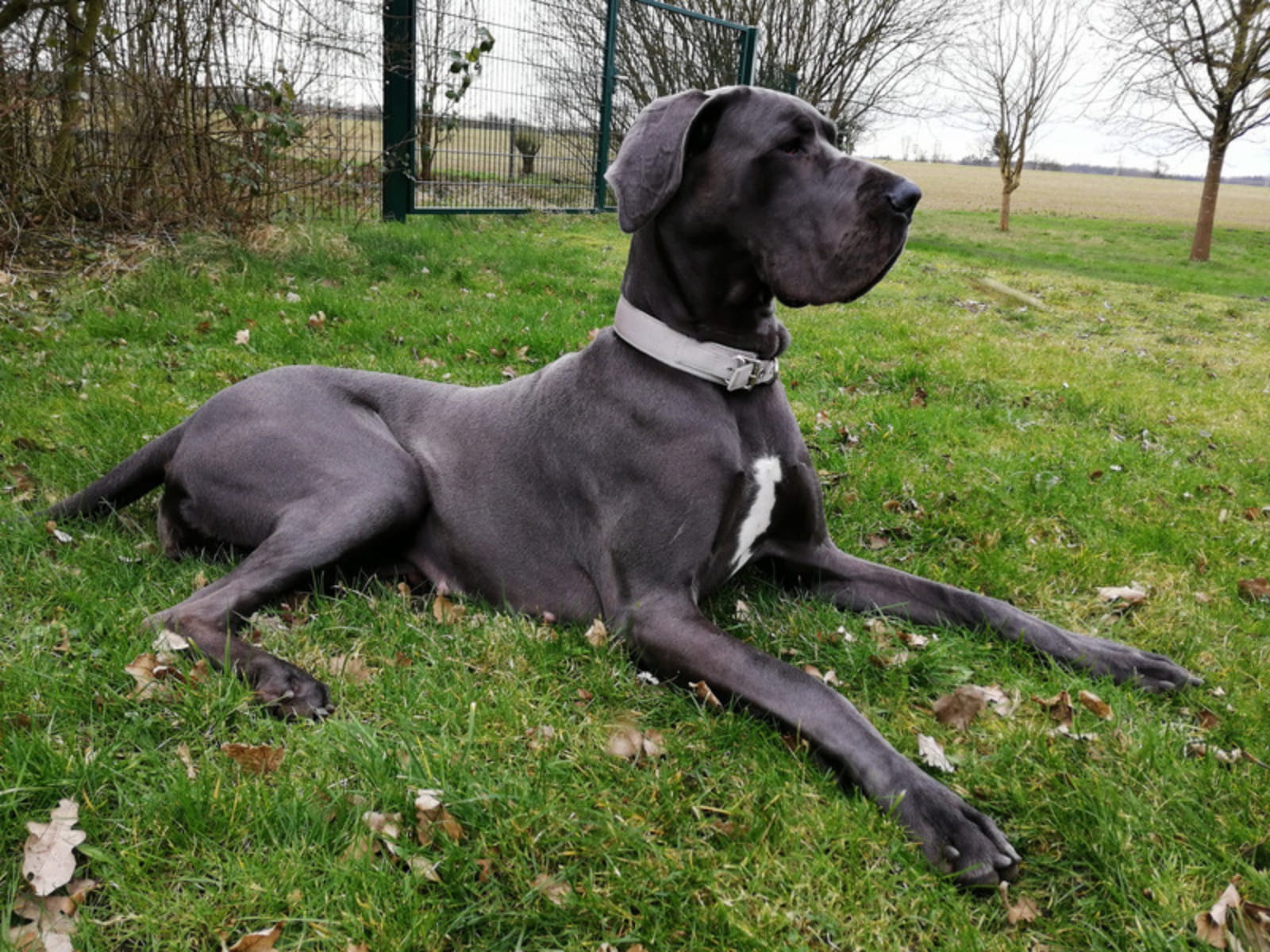
Blue Great Dane lying in the grass

Breed facts

FCI
no. 235 · group 2, molossoid, mastiff type
Origin
Germany
Height at withers
male 80–90 cm · female 72–84 cm
Exercise
more than 2 hours a day (according to the Royal Kennel Club)
Lifespan
under 10 years
Coat
short, sheds

The GoPuppy profile

These are breed averages and our own assessment. Your own dog’s age, fitness and training matter more.

  1. WalkingLong walksThe Royal Kennel Club gives more than two hours of exercise a day. Build up distance slowly until he is fully grown.
  2. Dog sportCalm gamesFor a dog of this weight we advise against jumping and running beside a bike. Obedience and scent work are fine.Suitsobediencescent work
  3. Terraces and cafésTerrace after trainingThe standard calls him 'friendly, loving and devoted to his owners', with 'high resistance to provocation'. He is calm but takes up a lot of space.
  4. Travel and staysRules or heat when travellingA dog this size does not fit every car or holiday home. Check in advance whether there is a size or weight limit.
  5. CityNeeds a big gardenThe Royal Kennel Club assumes a large house with a large garden.

Character

According to the FCI standard, the Great Dane is friendly, loving and devoted to his owners. He may be reserved with strangers, but the standard requires a confident, fearless, easily handled family dog with high tolerance and no aggression. Socially acceptable behaviour is, in the standard’s words, of the utmost importance.

Origin

As forerunners the standard names the old ‘Bullenbeisser’ and the boar hounds, midway between the heavy English mastiff and the fast greyhound. ‘Dogge’ at first simply meant a large, powerful dog, and the dogs were named by colour and size. In 1878 a committee of seven breeders and judges in Berlin, chaired by Dr Bodinus, decided to group all these varieties as ‘Deutsche Doggen’. The FCI places him in Group 2, section 2.1, molossoid breeds of mastiff type.

Colours

The standard has three colour varieties bred separately: fawn and brindle; harlequin (white with black patches), merle (grey with black patches) and black; and blue.

Health and size

The Royal Kennel Club gives a lifespan of under ten years and recommends hip, elbow and eye testing plus a DNA test for IMGD, an inherited muscle disease. Males measure at least 80 and at most 90 cm, females at least 72 and at most 84 cm.

Health: what a good breeder tests for

  • Hips (X-ray, official result)
  • Elbows (X-ray, official result)
  • Eye testing
  • DNA test for IMGD (inherited myopathy of Great Danes)

Ask for the parents’ results when you visit a litter. This is not medical advice; your vet knows your dog.

Breeders of this breed on GoPuppy

No breeder of this breed on GoPuppy yet.

GoPuppy does not check breeders’ health tests. A listing here is not a seal of approval.

Read also